

Will AI really replace us? (part 1)

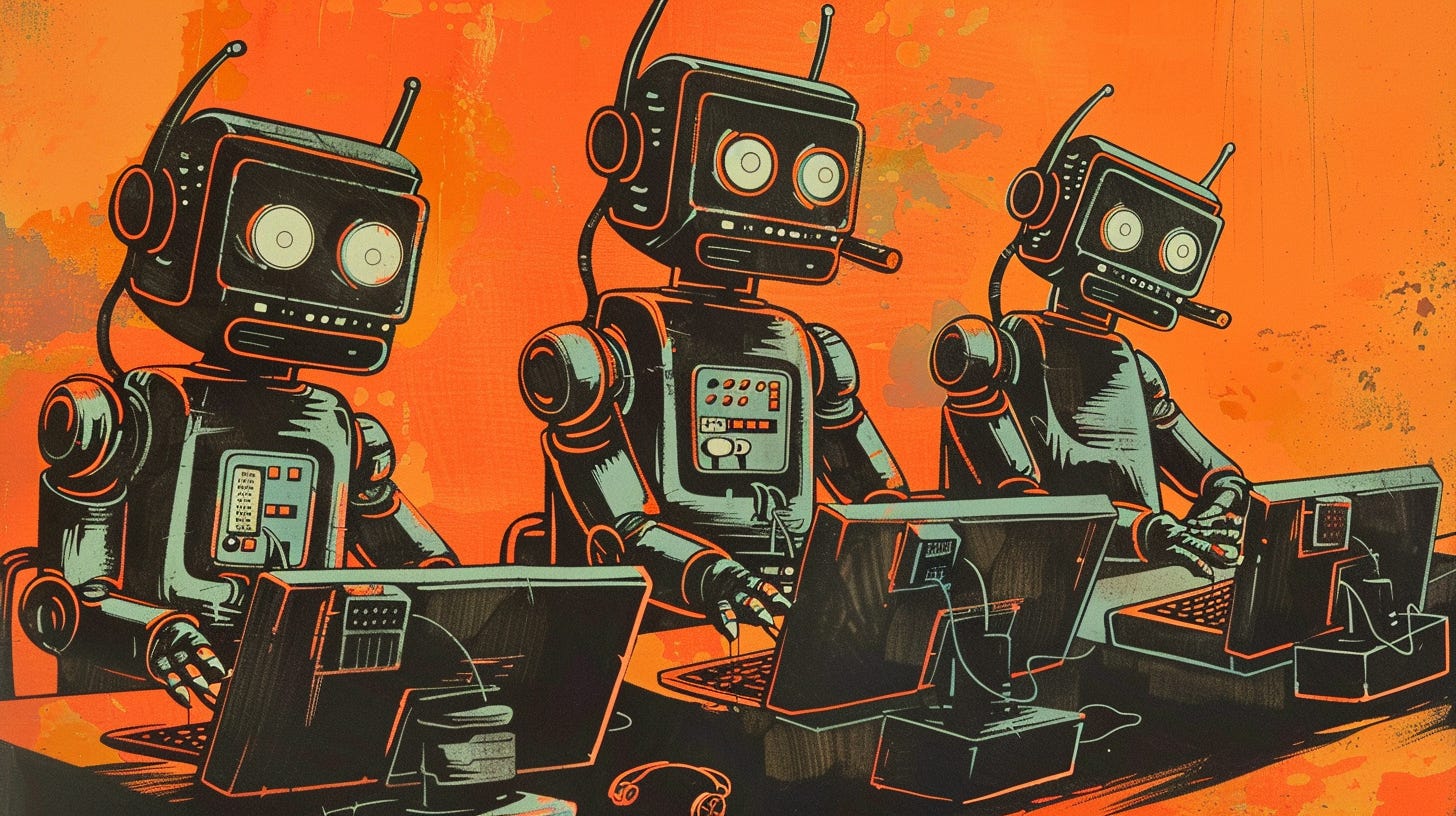
Last week, the buy-now-pay-later fintech Klarna published a blog post stating that two thirds of customer service interactions are now being handled by an AI assistant: the equivalent of 700 full time agents. The same day, shares in Teleperformance, the world’s largest contact centre outsourcer and a supplier to Klarna, fell by 19%. This drop happened despite the fact that in April 2023, Teleperformance had already signaled to the market that they expected 20-30% of its overall volumes to be automated over the next three years.
Is this the beginning of the end for contact centres? Is Klarna representative of what is to come? Or, once the dust clears from the some of the GenAI hype, will we see a future that is more nuanced?
Nobody can definitively predict the future, but I wanted to set out some personal thoughts on what could happen, and what companies and employees can do to prepare for it.
To do the topic justice, I’ve split it into three parts:
This week: a look back at how AI and automation affected contact centres in the last decade, to see what we can learn from the past
Next week I’ll lay out some potential scenarios and the impact they might have on demand and types of work in contact centres in the future
Finally, in two weeks’ time, I’ll set out what I think companies, employees and society at large should be doing to prepare
What the 2010s can tell us about what the future might hold
The below chart shows how the number of customer service representative roles in the USA grew between 2009 and 2019, in comparison to US GDP
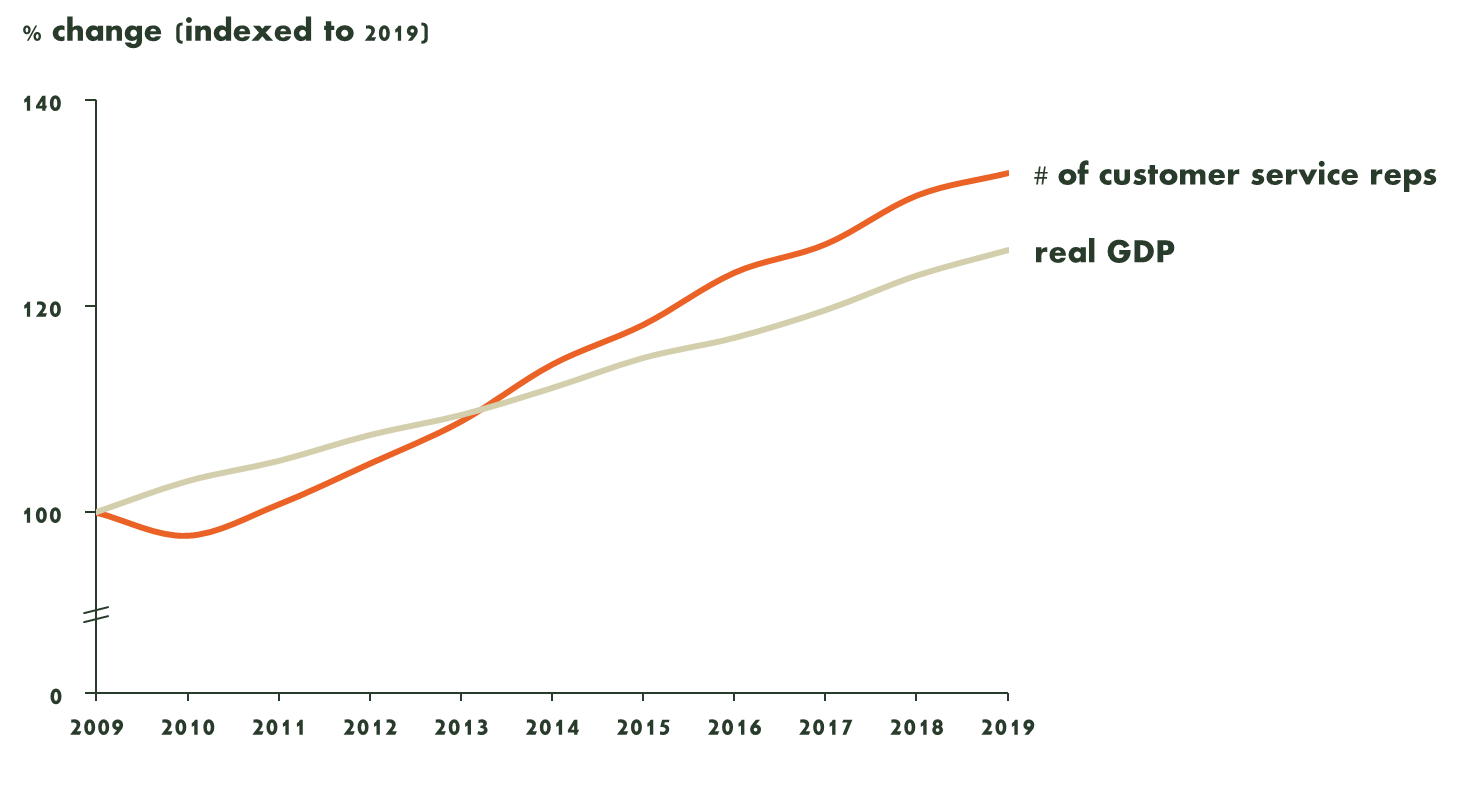
(Source: US Dept. of Labor Statistics, World Bank)
After a dip in employment following the 2008 financial crash, customer service headcount consistently outpaced economic growth for the whole of the 2010s.
A major factor in this growth was the contemporaneous growth of digital. This may seem counterintuitive - digital was billed as something that would automate most customer interactions - but consider the following five effects of digital:
Digital commerce means that more customers are transacting remotely, rather than in a retail store or bank branch. If they need help, they turn to the contact centre, not a face-to-face interaction
Digital services create new reasons for customers to contact: help with logging in, navigating websites/apps, security concerns etc.
Digital products at home are more complex: routers, smart speakers, connected games consoles, etc. all require remote support if customers need help
Digital customer service channels themselves drive increased contacts because they are typically easier to access. It is lower effort for a customer to initiate a chat interaction that it is for them to pick up the phone and navigate an IVR
Digital enables customer service representatives (CSRs) to do more value-adding activities during a servicing interaction, like making personalised offers to cross-sell relevant products and services
So although digital (including earlier iterations of AI) enabled the automation of many simple customer service interactions, and helped CSRs to work more efficiently, this saving did not fully offset the growth in new work created by digital. In other words, digital has enabled much greater overall value creation - increased sales, better customer experience - rather than being solely realised as an operational cost saving.
(there is one other main factor at play here: during a period of steady economic growth, companies were less concerned with trying to run their operations as lean as possible, so it is inevitable that inefficiencies crept in over time - this will have especially been the case in high-growth businesses like Klarna).
The question we need to consider is: will this next leap forward in AI create similar outcomes to those from digital - i.e. increased volumes, increased complexity of requests handled by humans - or will the pace of automation be so fast that there won’t be enough time for any offset?
Next week I’ll lay out some of the scenarios that I think are possible.
IWD 2024: five pioneering women who made contact centre history

To celebrate International Women’s Day, below are the stories of five women who played a pivotal roles in the advancement of contact centres and customer service
Sarah Bagley, who became the world’s first female telegraph operator in 1846 - arguably the first “contact centre” job. Throughout her career, Bagley fought for improved working conditions and the rights of women in the workplace.
Ethel (Jane) Cain, recorded her voice into what became the first UK speaking clock in 1936, one of the earliest automated phone services. This became a vital part of the national infrastructure during the Second World War.
Esther Rantzen, already a well-known television presenter in the UK, Rantzen founded Childline in 1986. The charity enabled children to access confidential, 24/7 support by dialing a free number, and is still going strong today.
Jan Smith was launch Marketing Director of First Direct bank in 1989. First Direct was not the first ever telephone bank, but it was first to capture the public’s imagination. Smith succeeded in explaining the concept to the public through a series of innovative marketing messages.
Callie Field was EVP of Customer Care at T-Mobile when she launched the now legendary Team of Experts model in 2018. This new way of working ripped up the rulebook for contact centres, empowering CSRs to collaborate to solve customer needs together.
Sadly, there are many other women whose vital contribution to the industry has not been recorded by history. Who are the female industry pioneers that you would want to recognise this International Women’s Day?
Recommended news articles
Latest perspectives from BCG
GenAI is about to transform banks front to back
In financial services, GenAI is widely seen as a potential gamechanger. The technology offers a chance to transform customer relationships and widen offerings of products and services.
Amid significant cost pressure, there is also a chance to reduce manual labour by a double-digit percentage.
But amid slow progress on implementation, the task for decisionmakers is to turn GenAI ambition into operational reality.