

Why reducing AHT doesn't always make customer service more efficient
The importance of modelling real customer behaviour

This week I'm sharing a story of an experience that taught me to carefully check my assumptions when planning the impacts of a customer service transformation. It taught me a bit about human behaviour on the way.
A few years back I was working with a financial services company that was struggling with long wait times in their contact centres, resulting in customer dissatisfaction. During the first phase of the project we had successfully designed and piloted a set of process improvements and automations that brought the average handling time (AHT) down by 50-60 seconds.
When we scaled up and trained the whole contact centre in these new processes, we saw an AHT reduction of over 40 seconds. Not quite the same improvement as in the carefully-controlled pilot, but still impressive. We were feeling happy. Our logic followed that a lower handling time per call meant that the same team could handle more calls, thus bringing down queue times.
But then we hit a problem.
Average speed to answer did drop a little, but not by the levels that we had modelled, and nowhere near the target. It wasn't enough to turn around customer experience.
We were flummoxed at first. It didn't seem to make sense. The shorter handling times should have freed up more capacity to answer calls. Then one of the data scientists on the team noticed something interesting.
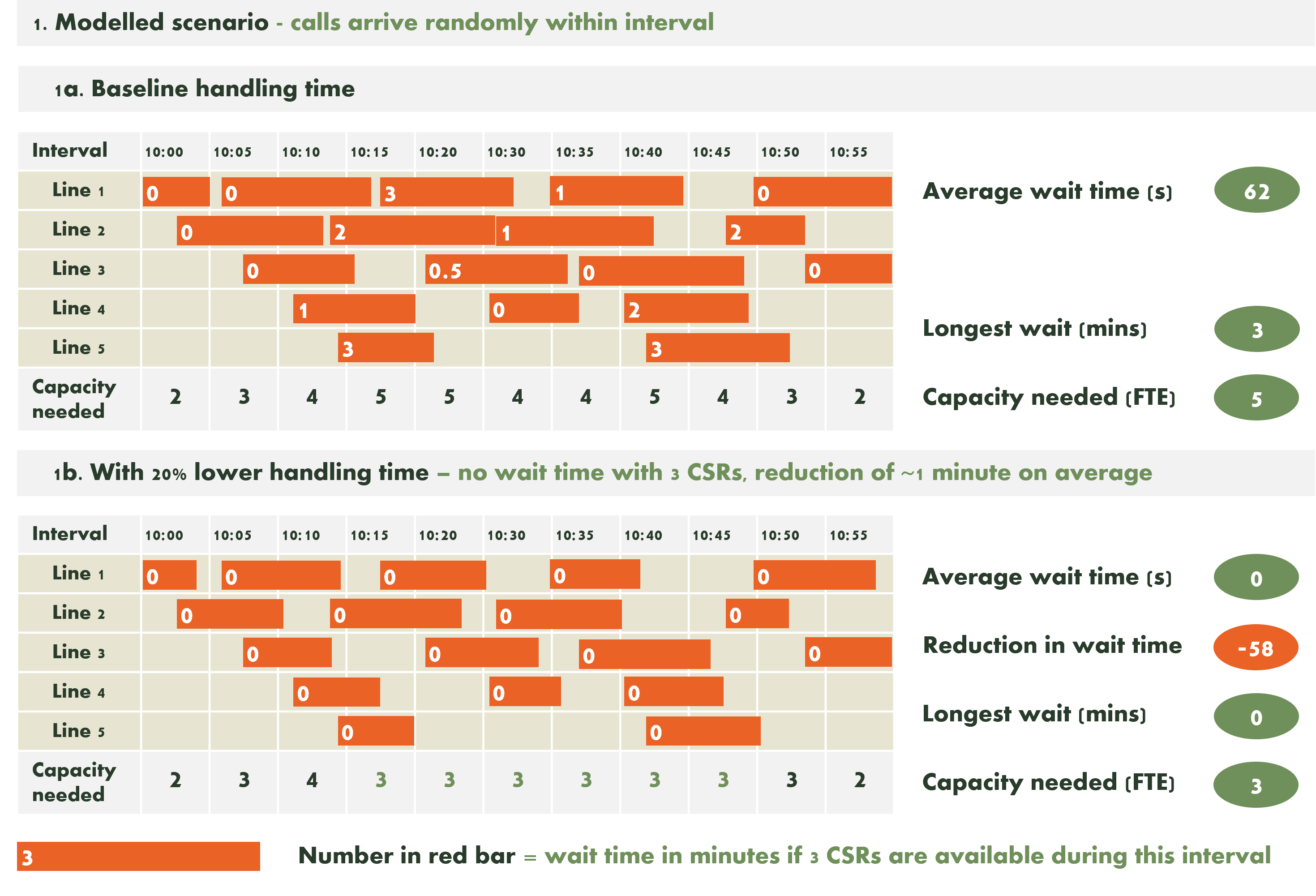
The industry-accepted way of modelling contact centre service levels is to use the Erlang C equation. This model assumes that new calls are added to the queue according to a Poisson distribution. Other articles are much better at explaining the maths than I could manage, but in simple terms, the model assumes that calls arrive randomly within a given interval. If calls do arrive randomly, then a reduction in AHT does generally correlate with shorter queue times, as Customer Service Reps get freed up earlier to take more calls (see Scenario 1 below).
But customers, as human beings, are not random. They make conscious decisions according to their circumstances. And this is what our data scientist noticed.
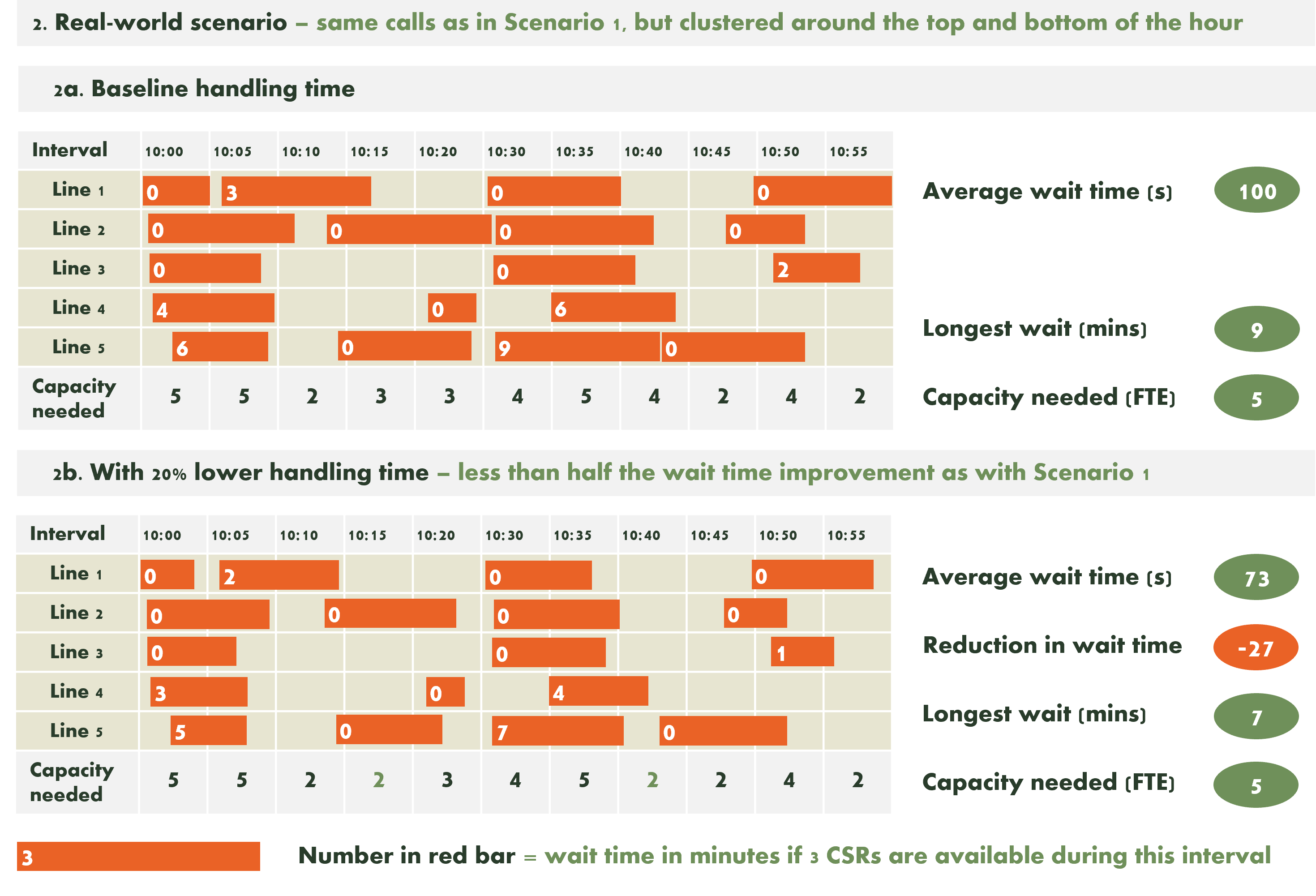
The arrival of calls being added to the queue, in the real world, did not follow a Poisson distribution at all. Instead, they were clustered around the turn of the hour, and on the half hour. With a burst of calls coming in every thirty minutes, the ASA was driven not only by the average demand within each half-hour interval, but by the total number of calls arriving during each burst period. Reducing AHT had a more limited effect on the total resource demand (see Scenario 2 below).
So, what was going on?
To find out more, we spoke to some customers, and we thought about our own experience as customers. What we discovered is that many customers were scheduling the time they would call customer service. They knew that wait times would be long, so they blocked out time in their schedules to make the call. Typically these planned times would start at the top or bottom of the hour, so we experienced a surge of calls.
This forced us to think differently about solutions. We took two main angles:
From a supply perspective: we shifted around CSR break and training times so that they were scheduled for 10 minutes past or 20 minutes two the hour, rather than on the hour and half-hour
From a demand perspective: we added a callback facility into the IVR which allowed a customer to stay in the queue, but hang up the phone. They would receive a call back once they are getting to the front of the queue
To take account of these real-world effects, at BCG we have started to use more advanced simulation tools that help us get better at predicting outcomes.
Recommended news articles
Generative AI accents are coming to call centers - is this a good thing?
MPowered Mortgages’ AI-powered chatbot solving 60% of broker queries
Latest perspectives from BCG
BHI’s Summer Reading List — 2024
In keeping with our annual tradition at the BCG Henderson Institute, we are excited to kick off the vacation season by unveiling our 2024 Summer Reading List
If you are taking some time to unplug, bring one (or more) of these books along and listen to our interviews with the authors.
The discussions reinforce why the books’ ideas are relevant to leaders—adding some inspiration to your vacation.