

Proactive and personalised service go hand in hand


Companies that have progressed the furthest with proactive customer service have made an important discovery: proactivity works best when combined with personalisation. In fact, some proactive servicing processes only work effectively and economically when applied in a personalised way to different customers.
Let me explain. Personalised service requires us to pre-empt a customer’s need and respond to that need ahead of the customer. But, all customers are different, and sometimes their needs are different, even when they are experiencing the same issue.
For example:
An internet connection outage that happens in the middle of the night will only affect customers who are awake at that time
A delay to a payment into a bank account would inconvenience most customers, but would be especially disruptive to a customer who is also due to have a large payment about to come out of their account
A delay to delivery of some new beachwear will be especially irritating to a customer who is going on vacation tomorrow
We can generalise this by thinking about customers in three distinct groups (see below diagram)
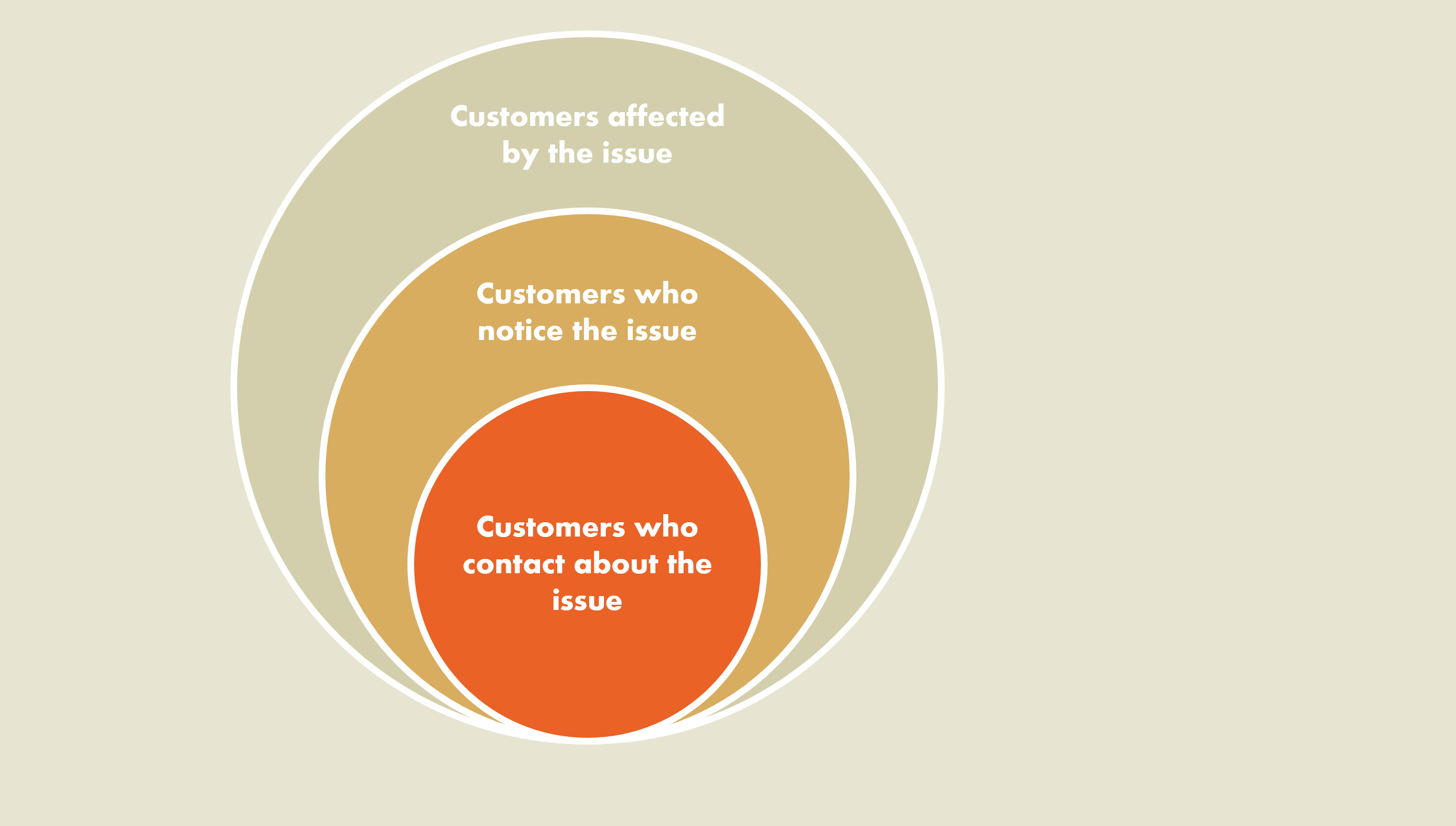
Customers who are affected by an issue but don’t notice it
Customers who notice an issue but don’t contact customer service about it (although they might, over time, decide to take their business somewhere else)
Customers who contact customer service about the issue
With proactive service, companies use data to try to detect which customers are most affected by an issue, then perform an action to resolve the issue, often in the form of an outbound communication to the customer.
By focusing the analysis just on the issue, without thinking about the actual customer experience, there is a risk that the outbound communications are sent to a range of customers, regardless of their actual need, as illustrated in the below diagram.
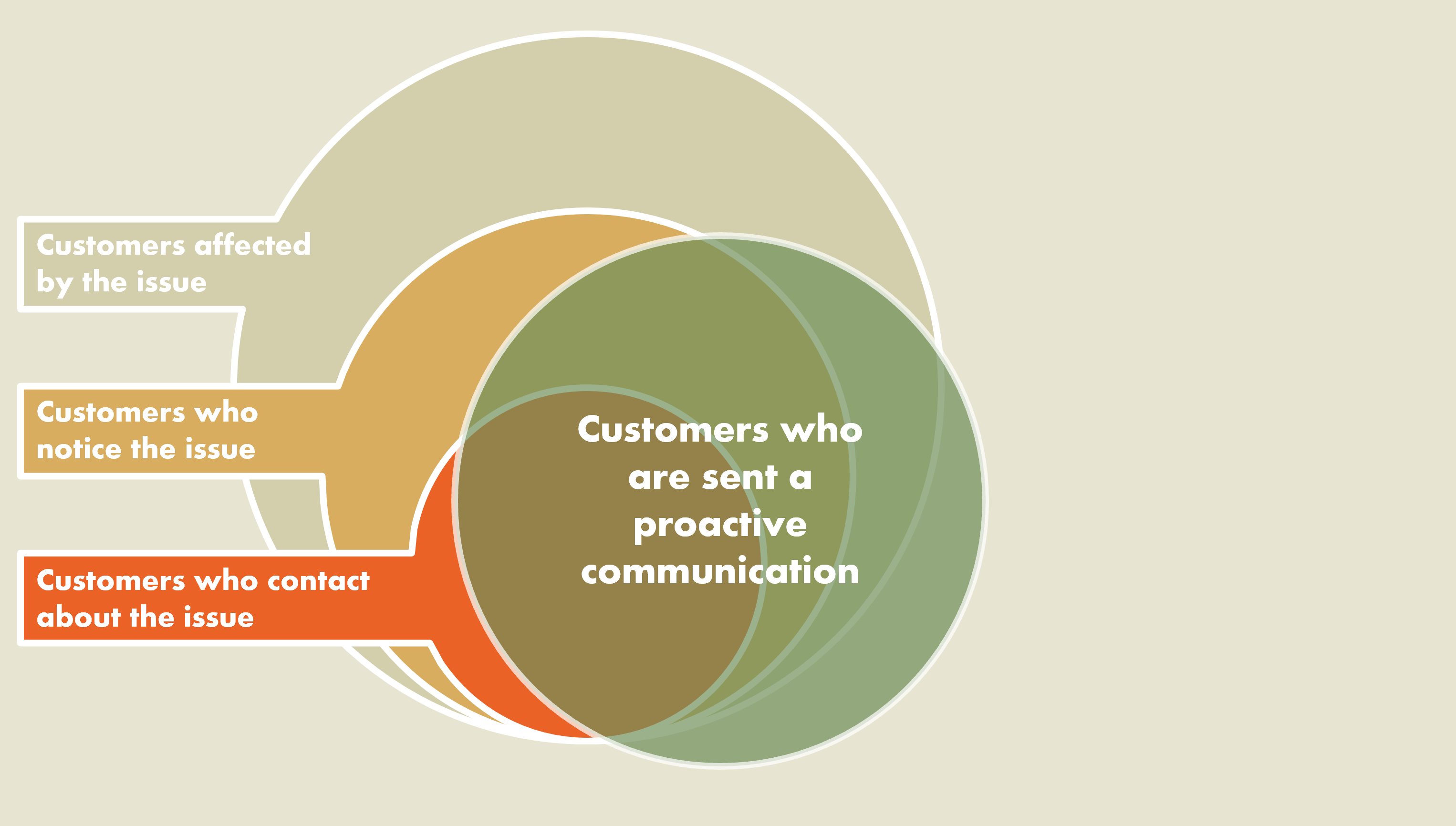
There are four main impacts that the proactive communication can generate.
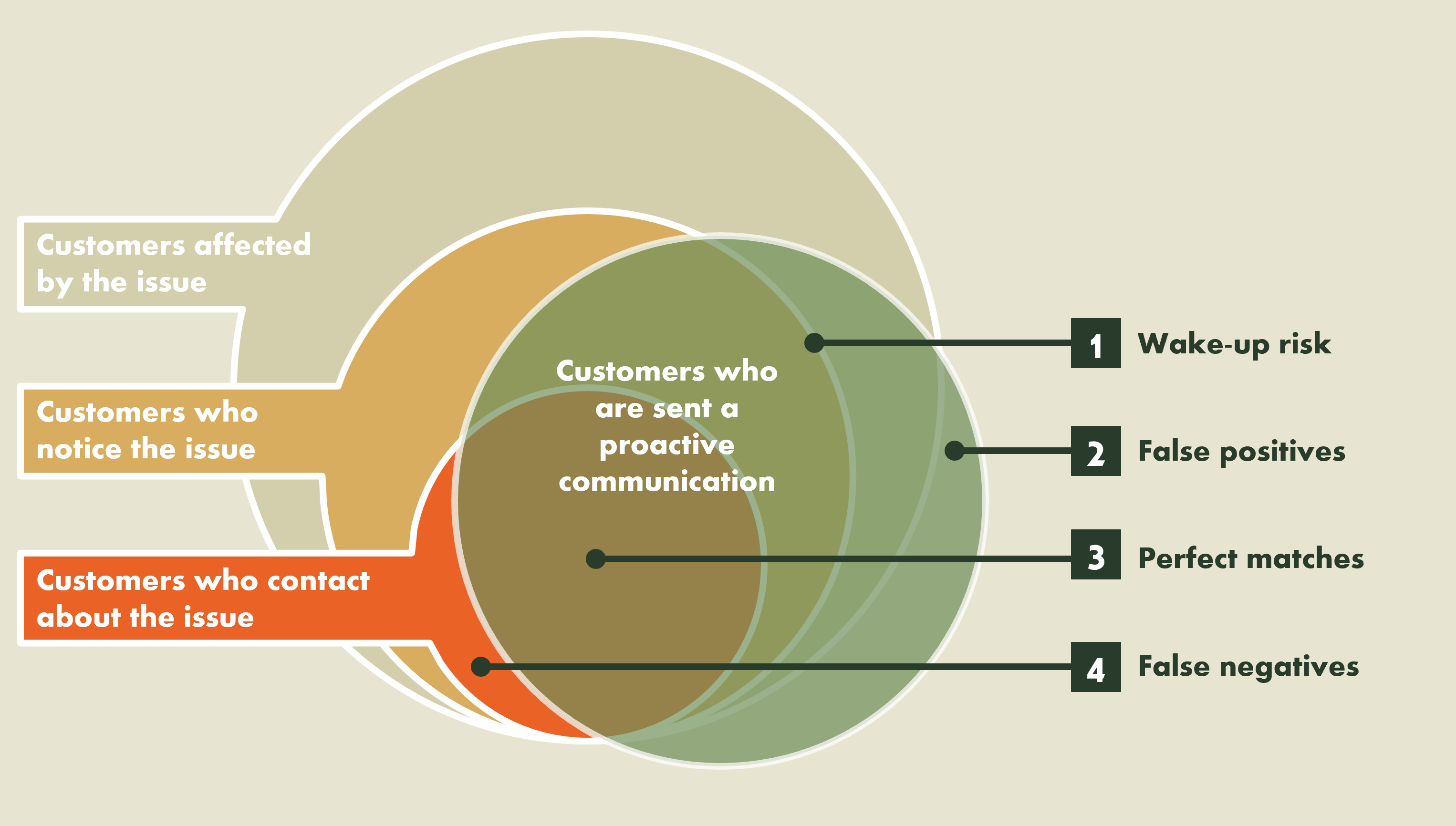
Wake-up risk: a communication is sent to a customer who would not have been too bothered by the issue. Instead they react to the communication itself and decide to contact customer service to find out more
False positives: often due to data timing issues, customers are sent a communication even if they are not affected by the issue, which can cause greater confusion
Perfect matches: these are the customers we really want to target, those who would have contacted customer service in response to the issue and will most value a proactive communication
False negatives: also often due to data timing issues, customers are not sent a communication, despite experiencing the issue - some of these will contact customer service
How personalisation is helping companies to be better at proactivity
Taking a personalised approach means not just measuring that an incident is occurring, but also measuring its actual impact on different cohorts of customers. This allows the solution to be better targeted to a customer’s specific response to an incident. Personalisation can take a number of forms, including:
Measure impact from the customer side: for example, detecting an internet outage not by using data from the central network, but by using data from the customer’s own router, to understand the actual impact on speed and performance
Learn from a customer’s history: for example, customers who complained about a price increase last time, are more likely to complain about one the next time around, so would benefit from more sensitive messaging
Extrapolate from similar customers: for example, if a group of customers with a specific brand of phone called in for technical support when the company’s app was updated, then check if other customers with the same brand of phone are experiencing similar issues
It is still early days for many of these approaches, and even the most technologically mature companies are still exploring ways to use AI to extract insights from call and chat transcripts that can drive personalised proactivity. But, to me, this is one of the most exciting fronts in the development of better customer experiences.
Recommended news articles
Follow the money: 5 investments in AI & customer service technology
How companies can use AI to better serve deaf and hard-of-hearing customers
Almost 40% of UK customer service workers facing abuse consider quitting
How poor customer service costs you a fortune and takes a mental health toll
Worker who mistakenly sent abuse to customer wins unfair dismissal claim
Latest perspectives from BCG
How to accelerate the GenAI revolution in sales
GenAI use cases are particularly compelling in sales, fostering more productive, more adaptive, and more effective interactions between sales teams and customers.
Unleashing GenAI often proves challenging, however. Companies need to focus on algorithms and technology, but even more so on people and processes.
Three factors are key for sparking a revolution across the sales value chain: unlocking data, encouraging adoption of GenAI solutions, and building trust into AI-powered processes.