

Forget about handoffs. The future is jazz.


“AI handles simple customer requests, then hands off anything too complex to a human.”
It’s a simple enough statement that forms the basis for thousands of customer service strategies across the globe.
Here’s the problem: it doesn’t really work in practice. For lots of reasons.
It can be remarkably difficult to tell how complex a customer’s need really is, and this complexity often doesn’t reveal itself until a long way into the conversation. As a result, handoffs don’t happen when they should, and do happen when they shouldn’t.
Complexity is dynamic: a customer may have one question that requires judgment and a nuanced answer, but then may go back to needing a simple workflow to resolve everything else. But it’s usually not possible to hand a customer back to the AI.
Handoffs create friction, where customers need to wait for a human Customer Service Representative (CSR) to be available, and may need to explain their need multiple times
Handoffs reinforce silos. More often than not, one leader looks after the AI and another leader manages the CSRs. There is no accountability for what a customer actually experiences.
It’s little wonder that for many companies, the number one utterance from customers presented with an AI chatbot or voicebot is some variation on “Agent! Agent! Human! Human!” Customers don’t trust the handoff algorithm and want to go straight to the human from the outset.
The answer is to offer something a little more jazzy…
The oversight rhapsody
Fortunately, agentic AI is offering an alternative to the flawed handoff paradigm.
Instead of AI handling only the simplest requests, it instead becomes the primary interaction point for virtually all interactions. Oversight of this AI is provided by a combination of automated evaluation & control systems working alongside human operators. These human operators are able to intervene, dynamically, in any customer interaction in a number of ways:
Authorise - approve a response or action from the AI Agent before it is presented to the customer
Prompt - write a prompt which steers the AI Agent in the right direction
Intervene - write a response which is delivered to the customer verbatim, before the automated flow resumes
Takeover - fully take over the conversation with the customer. This is the equivalent of the hand-offs described above, but is only needed for a small fraction of exceptions
Flag for offline evaluation - tag the conversation to be evaluated in greater detail by an offline reviewer, to identify opportunities to improve AI performance and outcomes
This is a system that allows for dynamic human-in-the-loop operations, where needed, but without a full hand-off from AI to human in most cases.
This system also needs to solve for the scaling problem: how can human operators effectively monitor the moments that matter, without having to monitor every single interaction. Key design features enable this:
The human-in-the-loop is at the far end of a multi-stage, AI automated evaluation and control system that has already checked for factors like accuracy vs. ground truth, output toxicity, information security, regulatory compliance, tone of voice etc.
That same AI evaluation system also assigns a dynamic risk and value score to each interaction and flags conversations that should have human oversight
The human operator is able to exercise their own judgement - presented with a screen of multiple interactions, they can choose where to interact based on a colour-coding of risk (see example screenshot below)
The overall process owner is able to set the boundary conditions for a case to be flagged, and adjust this over time based on the real world performance of the AI
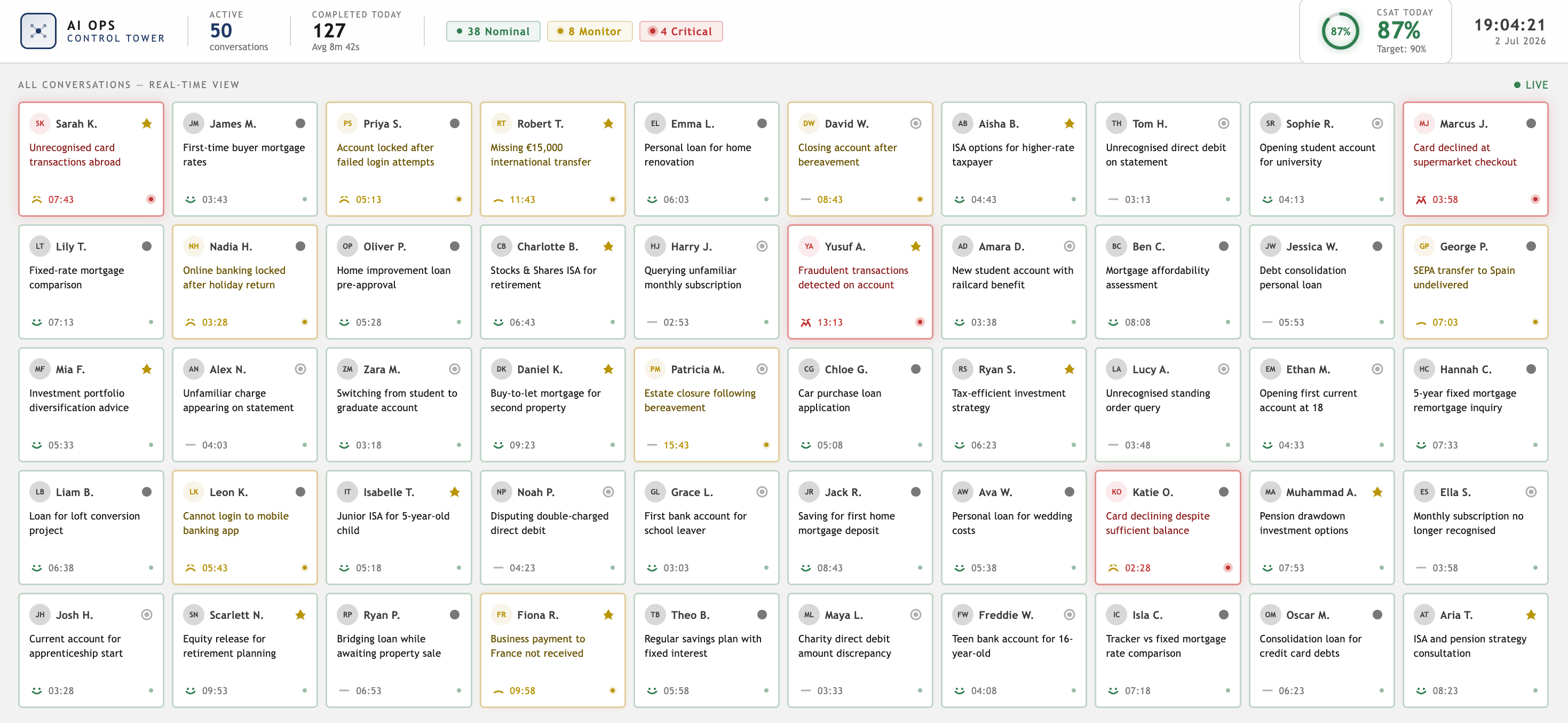
We talk a lot about orchestration, but this is more like a jazz band than an orchestra. Human experts listening and responding in real time to changes in the situation, but working together as a cohesive whole.
We are starting to see some vendor solutions to this in the market, including Cresta’s Agent Operations Center and Agent Control Tower from GetVocal. I expect to see - and am excited to see - the variety and maturity of these sorts of solutions evolve rapidly.
Recommended links
Forrester: AI will reshape customer service jobs in dramatic ways
TechTarget: Genesys acquires Pinkfish to speed up contact center AI deployments
CX Dive: A CX culture is just marketing if there’s no buy-in, experts say
Fast Company: Consider your customer’s reaction before automating
Latest perspectives from BCG
Return on AI: what CEOs need to know about the true cost of artificial intelligence
The fast-rising cost of AI tokens puts pressure on CEOs to measure how much the intelligence costs and what it creates
As the total token bill scales up fast, companies lose track of how much they are spending—or on what
The companies that pull ahead will not be those with the smallest or largest AI bill; instead, they will be the ones that produce the highest return on AI
Tokens hit the P&L on three separate lines—capex, opex, and cost of goods sold. CEOs should ask their CFOs and CIOs to start allocating costs accordingly